Wednesday, July 8, 2009

Kilauea Volcano Update

Kilauea activity update - from the US Geological Survey, Big Island

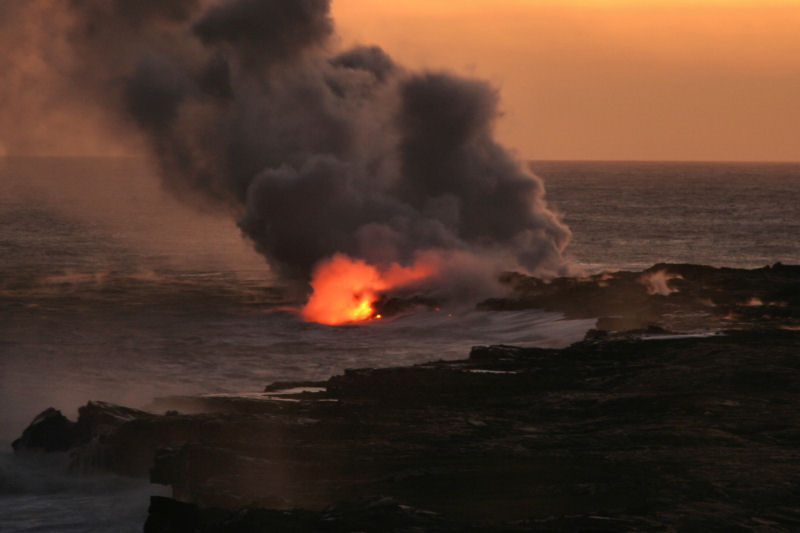
Surface flows in the Royal Gardens subdivision slowed early this past week in response to a deflation-inflation event at Kilauea's summit, but had picked up again by Wednesday evening. At the coast, the Waikupanaha and Kupapau ocean entries remain active and continue to produce prominent plumes, accompanied by small littoral explosions as lava spills into the ocean.

At Kilauea's summit, a series of collapses in the vent within Halemaumau Crater on Tuesday caused a significant widening of the vent. Rubble from the collapses filled the bottom of the vent and partly choked off the emission of gas, resulting in a wispy plume. Despite this rubble, the vent is still emitting elevated amounts of volcanic gas, resulting in high concentrations of sulfur dioxide downwind. The glow from the vent, visible early in the week from Jaggar Museum, was extinguished by the collapses. However, a webcam recorded a few points of incandescence within the vent on Wednesday night, suggesting that lava still resides deep within the vent below the pile of rubble.

Five earthquakes beneath Hawaii Island were reported felt this past week. A 3.5 magnitude earthquake occurred at 8:39 p.m., on June 28 and was located 2 miles southeast of Makawao, Maui, at a depth of 19 miles. Three earthquakes with magnitudes between 2.4 and 2.6 occurred on Tuesday (one at 1:38 and two at 2:29 p.m.), and were located beneath Halemaumau Crater at depths between 0.9-1.1 miles. A 3.3 magnitude earthquake occurred at 10:45 p.m. on Tuesday and was located six miles northeast of Kukuihaele at a depth of 16 miles.

Labels: , ,

Kona’s ‘Project Compassion’ To Serve Up Denny’s Dinners To Support Newborn Baskets for Big Island Babies

Join us at Kona Denny's on July 12th from 4:00 - 9:00 PM

6,000+ babies…and counting. That’s how many Hawai’i Island infants have received an absolutely free newborn basket within 24 hours of birth at a Big Island hospital over the past 5 years.

The newborn baskets, part of the “Baby Steps To Stronger Big Island Families” program, are meant to welcome infants into the world and provide research-based “tools” to help each child and his or her family receive the best possible start to family life. Supported by grants, private donations and thousands of volunteer hours, the project started in December 2004 as a response to Mayor Harry Kim’s community-driven “Kick ICE” initiative.

The community is invited for a delicious dinner between 4 and 9 p.m., Sunday, July 12, 2009 at Denny’s Restaurant in Kailua-Kona to support the newborn basket project through “Project Compassion,” a partnership between the Rotary Club of Kona, Denny’s and local charities to provide financial support to non-profit organizations working in the community.

Denny's will donate 20% of all dinner bills and 100% of all tips to “Baby Steps To Stronger Big Island Families” newborn basket project.

The baskets most notably include a $30 Snugli (a front-pack baby carrier), which is very handy for carrying an infant hands-free. But, more than a nice thought or helpful convenience, the contents of the gift basket are based on research showing use of a Snugli promotes a caring, safe, bonded relationship between an infant and his or her family. These stronger first relationships significantly define and enhance a newborn’s relationships throughout life. Better relationships equate to higher self esteem, which experts agree help with making better choices throughout life.

Newborn baskets also include baby’s first book, useful information for new moms such as SIDS prevention, how to install car seats, and a comprehensive Resource Directory to help anxious new families connect with services in their community. “Newborn baskets have been a huge hit all over the island because they are such a lovely way for the community to celebrate the birth of a new child,” said Angela Thomas, who has led the project from its inception.

“But presenting every new mom with a lovely gift is really just the tip of the iceberg. Because of solid research about the significant value of attachment to infant development, our project has been supported by many public and private partners – from KTA SuperStores to the Hawai’i State Legislature to Governor Linda Lingle and Lt. Gov. Duke Aiona to Kamehameha Schools and many more, including nearly a hundred volunteers who have spent more than 5,000 unpaid hours assembling baskets for our island’s three major hospitals.”

“Denny’s Restaurant and the Rotary Club of Kona, through “Project Compassion” are helping to keep these Snuglis and gift baskets being delivered to Big Island hospitals. You can help ensure that our Big Island babies thrive by dining at Denny’s on Sunday, July 12, between 4 and 9 p.m.,” Thomas said.

Waiting on customers during Denny’s “Project Compassion” dinners will be a cadre of VIP “wait help” including LAVA105FM’s Sherry Bracken, Susan Maddox of Friends of the Future and North Hawaii Rotary’s newly installed President, Family Support Services of West Hawai’i’s JoAnn Bishop Freed, Kona-Kohala Chamber of Commerce’s Bill Sanborn and Vivian Landrum, PATCH’s Gail Judd, Hawaii Community Foundation’s Diane Chadwick and several surprise guests.

No reservations are needed for Denny’s “Project Compassion” dinner. For information about “Baby Steps To Stronger Big Island Families, call Angela Thomas (990-6754).
* * *
Editor’s Note: Data on the significance and value of “attachment” and bonding and the benefits of using a Snugli is available by calling Angela Thomas.

Labels: , ,

Sunday, June 7, 2009

Download - Big Island E-Book

For a mere $2 you can download the 30+ page Big Island Vacation Planner electronic book in easy to read and easy to print PDF format. Our E-Book includes much of our website information in a concise, easy to maneuver E-Book. Want a paper product or brochure to take with you on your trip?

This E-Book is perfect for planning your next trip - and since you download it right to your PC or notebook, you won't need an internet connection to use this product. Once you download our E-Book, you will always have access to the best information on what to see and do on the Big Island of Hawaii!

Download the E-Book and print it out now!

Labels: , ,

Sunday, March 22, 2009

Winter Weather in Kailua-Kona


The following was a question emailed to us:

We are looking forward to the Kailua-Kona area. We have never been in early December or the middle of January. Just wondering what the weather would be at that time.

Thank You,

Ron & Miriam

--------------------------

Answer:

Ron and Miriam, your winter weather (Dec and Jan) is mild and still extremely enjoyable. Daytime temperatures rise into the 80s and at night drop into the 60s. Surface water temps are in the mid to high 70s.

Take caution, in the winter the western shores (Kona) can be rough with ocean swells making diving conditions less enjoyable - especially late in the day.

If you will be traveling to Waimea or Volcano, both are at higher elevations and can be cold and rainy this time of year - pack at least a fleece and rain coat.

Beachgoing in Kona is still excellent in the Winter - sunny skies will dominate. For more details check out our Big Island climate page and our Big Island weather page.

Labels: , ,

Monday, March 9, 2009

Question: Where Should I Stay?


A Question was emailed to us:
I am planning a trip May 6-10 2009. I have a 8 year old son and my boyfriend. I need to find a hotel good for kids and possibly nanny service if we decide to go out one night. I also would take any suggestions as to what part of the big island is good to stay. Thank you, Stacey
--------------
Answer:
Stacey,
We recommend the Hilton Waikoloa Village hotel - it is definitely family-friendly with tons of activities, its own private lagoon, huge waterslides and pools, and more. It is a spectacular resort with 62 acres of jungles, waterfalls, trails, pools, rivers, trams, boats, shopping, dining, dolphins, and activities. Located on the Kohala Coast of Hawaii's Big Island, the Hilton Waikoloa Village lets you experience breathtaking tropical gardens, abundant wildlife, award-winning dining, world-class shopping, art and culture, and an array of activities ranging from golf and tennis to an interactive dolphin program and the Kohala Sports Club & Spa.

However, the night life at the Waikoloa is really dull. Your best bet for night life is to drive down to the town of Kailua-Kona (although you will have to drive back at the end of the night too..) Althought Kailua won't be mistaken for a bustling downtown Waikiki or anything close, it does offer various beach bars, a great brew pub (Kona Brewery), the Hard Rock Cafe, and numerous other watering holes.

I must warn you, the Big Island is NOT renowned for its night life, its daytime activities are incredible, however. Whether you stay near Kailua-Kona or up in Kohala (where the Waikoloa Village is located) you are near immaculate beaches, great snorkeling, and tons of sunshine!

Labels: , , ,

Question: Where Can I View the Lava Flow?


One of our users emailed us the following question:
Can you tell me if it's currently (and has been recently) possible to hike to the lava flow & see it relatively close up? Or is the only way to see it via helicopter?
Thanks, Dan
-----------------------------
Answer:
Dan, Because the volcano lava flow is so unpredictable, the best thing to do is check the latest Kilauea volcano lava flow update, or call the Park at (808)985-6000. You can also view a map of the most current lava flow.

Depending on the conditions, you MAY be able to view lava/volcanic activity at one, some, all, or none of the below:

a.) Red-glowing vent/smoke plume from the Halemaumau Crater vent (Crater Rim Drive).
b.) Ocean entry lava flow - a 1-3 mile hike from the end of Chain of Craters Road.
c.) Surface and/or ocean entry lava flow north of the Park - accessible via county road outside of the Volcanoes National Park.

Check out our Kilauea Lava Flow web page for more details.

Labels: , , ,

Tuesday, February 24, 2009

Download Big Island Brochure

We have received numerous requests for brochures, magazines, and guide books from our site. We do not produce any printed guides as our main product is our website. However, due to popular demand, we have begun work on a downloadable e-guidebook. This downloadable book will contain the main parts of our website in an easy to reference and printable format that you can take with you on your trip.

Although our online material is still our centerpiece, this downloadable guide will allow you to take our product with you on your trip and it wil aid you in planning you Big Island adventures. More to follow soon.

Labels:

Saturday, February 14, 2009

Car Security at Big Island Dive Sites

Below is a question submitted by one of our users:

Comments: I am planning on diving on the Big Island this March and really appreciate the reviews on the shore diving sites. I was wondering if vehicles are frequently broken into while they are parked at the dive sites? For example at Puako Village End.
Thanks
Bill
-------------------
Bill,

When parking your car at any dive site on the Big Island (or at any hiking trail head too), make sure you sanitize your car -- that is ensure nothing of any value is visible. Minimize the temptation of thieves to want to break into your car. That means don't leave anything on the dashboard, console, seats, etc. to include sunglasses, cell phones, DVD players, any bags/purses/luggage, shoes or gear, etc. Basically clean out your car as if you were returning it to the car rental place...

With that said, I often dive from austere dive sites on the Big Island as well as park my car in strange (unsecure) places when I go hiking. My car was fine when I dived at Puako. Most of the guide books will talk about crime and securing your vehicle - keep your car sanitized and you should be fine... Enjoy your trip!

Labels: , ,

Tuesday, February 3, 2009

Laupahoehoe Music Festival


Laupahoehoe Music Festival

Malama Hawaii Nei was formed 5 year’s ago to manage the Laupahoehoe Music festival after Big Island musician Bruddah Smitty desired to do some thing to help the children of the community of Laupahoehoe. It is a committee of volunteers whose sole purpose is to provide scholarships for area students as well as fund community projects. Last year, five college scholarships were awarded from proceeds from the event.

Malama Hawaii Nei presents its fourth annual festival at beautiful Laupahoehoe Point Beach Park on Feb 14 form 9:00 am till 5:00 pm

Featured entertainers include The Lim Family, Sugah Daddy, Times 5, Beamer-Solomon Halau O Po’Ohala, Johnny Shot, Hula Halau O Mailelaulani, Bruddah Smitty and Friend’s, Mixjah and Robi Kahakalau. Food and Crafts available. Hosted by Tommy “Kahikina” Ching and Skylark Rosetti.
Lot’s of grinds and crafts too!

Tickets are $10.00 and are available at the Taro Patch in Honokaa, Music Exchange in Hilo and Waimea, Hilo Guitars & Ukulele’s, Mr. Ed’s Bakery in Honomu,50’s Café in Laupahoehoe and at the gate. Age 10 and under free and no coolers please. This is an alcohol and drug free event.

Labels:

Wednesday, October 22, 2008


One of the most striking things first felt by new and recurring visitors to Hawaii, is the overwhelming sense of fertility, the lush vegetation, the sweet smelling flowers and orchids right when you get off the plane in the open air airport. Right as you arrive, the wonderful smells of plumeria flowers, blooming orchids, and tropical flowers and fruits will overcome you. Although the big Island boasts nearly a dozen different climate zones, the most memorable is the tropical vegetation. You get a great sense of this as your aircraft circles the north eastern slopes of Mauna Kea on your arrival into Hilo airport and as you look below and to the right of you, you see dense green jungle weaving its way on the eastern slopes of the volcano. As you peer down through your airline window, you will make out many streams and river tributaries spilling from waterfalls that are carved into the sides of the ocean cliffs. On the Hamakua Coast, the lush jungle vegetation creeps right up to the edge of the rocky shoreline carved out by steep gullies and the occasional dousing rain shower. The beautiful tropical flowers are everywhere, starting right there at the airport with the sweet smelling leis hung from visitors necks. The ever present lightly blowing Pacific breeze brings all the fresh smells of nature right to you. Even the rainstorms here on the big Island, bring an added sense of freshness that you just don't feel from the precipitation on the mainland.


You can get a sense of the wonderful harmony of green trees and perfectly manicured flowers at the local Japanese gardens such as Queen Liliuokalani Gardens in Hilo. For greater adventure, take a trip to the Hawaii Tropical Botanical Gardens situated on the Hamakua coast. Here, you can indulge yourself in an extensive garden that offers winding nature trails surrounded by tropical flowers, plants, trees, and great views of the dramatic coastline as it gets pounded by the waves. To get a real sense of the dense vegetation that covers such a large portion of the big Island, all you need to do is take a short trip and hike around the rain forests nearby. You can come up close and personal to the beautiful rain forest in the volcanoes national Park. As you drive down the Chain of Craters Road, you'll wander through the canopied rain forest and see prehistoric-era ferns swarming the sides of the road. Also, close to downtown Hilo, is Rainbow Falls where you can see the swollen falls after a rainstorm and admire the tall trees and fertile wilderness. At the edge of Hilo town, is the Panaewa Zoo where you can also get a very good sense of the rain forest. On the surrounding hills, is foliage so thick walking through will bring ground brush up your thighs or waste. Yes, Hilo is the green side of the island and you can expect nothing less than a fertile aromatic paradise – in between rainy downpours.

Labels: ,

Sunday, July 13, 2008

One Day is Not Enough for the Big Island

Recently, friends of mine were visiting the Big Island from the mainland and used the website to help plan their upcoming trip. They were planning on visiting Oahu and then the Big Island. They took a look at the website and spoke with me and then started to plan their itinerary. Unfortunately, they only allowed themselves one day for the Big Island - flying interisland early in the morning, renting a car, then departing late at night back to Oahu.

I tried my best to entice them to stay for more than one day in order to see all that the Big Island had to offer. Sure enough, their trip to the Big Island was a whirlwind tour with a very quick pace to visit just a few of the attractions. They ended up flying into Hilo, driving up to Akaka Falls, then down to the Volcano Park and sightseeing and hiking until the end of the day.

I can't emphasize it enough for those planning trips to the Big Island -- there is just too much to see and the Island is so big and spread out that one day is just not enough. You have to allow yourself several days (at least) to see the attractions, and even then, you will probably have to just pick a few things your really want to do and stick to them - or you'll end up with an overwhelming trip with a tight itinerary and no time to enjoy the sights or soak it all in. Remember, the Big Island is bigger than all the other Hawaiian Islands combined and the attractions are spread out throughout its coasts, mountains, and inland highlands.

Check out our Big Island Trip Itineraries section with suggested itineraries for your trip.

Labels:

Monday, February 18, 2008

Visiting the Big Island Without a Car

Recently, friends of mine visited the Big Island of Hawaii. Naturally, I tried to help them plan their vacation - I offered tips on where to go, what hotel to stay at, and overall tried to steer them towards the http://www.letsgo-hawaii.com/ website for all of their vacation planning needs.

Unfortunately, I must have forgotten to mention that they would need a rental car (but, who goes on vacation without renting a car?)... Well, these friends arrived at Kona Keahole Airport without any plans for a car and then simply took a (very expensive) taxi to their hotel in Kailua-Kona town and began their vacation. Later on I did find out why they did this -- although they had never been to the Big Island, they had previously visited Oahu many times and were impressed with the robust public transportation system that exists there (namely the public bus) -- they thought the Big Island 1.) was smaller with attractions closer together and 2.) there was good public transportation. Wrong on both counts.

So, for the first several days all they did was venture a short walking distance from the Royal Kona Resort hotel on Alii Drive -- never even making it to the Kohala area beaches or Kahaluu Beach Park, or Captain Cook or South Kona -- because they did not have a vehicle. They remarked to me later, "There are no beaches on the Big Island!" - and I thought to myself, what a strange thing to say (until I realized they never even made it to the beach!) Eventually, for the last few days of their trip, they rented a car and drove to the Volcanoes National Park, Hilo, and then up the Hamakua Coast and back up over to Kona - probably the best part of their trip.

So, the moral of the story is - RENT A CAR on the Big Island. There is so much more to do and see and everything is so spread out compared to the other (smaller) islands. Rent a car (and pack some comfortable walking shoes) and you will be able to access all of the islands splendid attractions.

Labels:

Saturday, August 11, 2007

Big Island Has No Beaches?

I recently spoke with friends of mine that took a trip to Hawaii a few years ago. I asked them what island they went to and they responded "the Big Island - you know, the island with no beaches!" Needless to say, I was shocked that they thought of the Big Island as a place with no beaches!

Certainly, there is no Waikiki equivalent on the Big Island, but any visitor or resident will let you know there are plenty of beaches on the Big Island to satisfy anyones beach-going taste. I immediately guessed that my friends probably stayed in a hotel that did not have an adjacent beach. I was right, they stayed at the Sheraton Keauhou Bay - which is perched on lava sea cliffs overlooking the ocean, but with no beach in the vicinity. It is too bad that my friends did not inquire with the hotel staff or any of the slew of tourist guides to find out that there are many great beaches on the island and some very close by.


If you are not staying in a hotel in the resort-laden sunny Kohala Coast, you will have to drive to the beach. But once you get there, your trip would be well-worth it. Instead of long, established beaches such as Waikiki, the Big Island boasts dozens of smaller beaches surrounded by natural beauty (instead of the towering skyline of hotels and condos). You will find every variety of beach - white sand, black sand, grey sand, and even a green sand beach. Some are located just off the main roads with paved parking lots, showers, and bathrooms - such as Kahaluu Beach (Kona) and Hapuna Beach State Park (Kohala). Others, like Makalawena Beach (Kohala) are more austere and require you to hike to reach them. There many secluded beaches that you may be the only one there or just one of a small handful of people - such as Kekaha Kai State Park (Kohala).

If you like undisturbed natural beauty, you will love the beaches of the Big Island. Even popular beaches like Kua Bay (Kohala) and Punaluu Black Sand Beach (Ka'u) are set against their natural surroundings - be it dried lava beds or clusters of shady palm trees. This is the Hawaii we day-dream about. The fact is you could visit a different beach each day of your vacation on the Big Island.

Check out our Big Island Beach Guide for reviews, photos, and maps of all the beaches on the Big Island. We detail how to get to the beaches and which ones are best for sun-bathing, swimming, and snorkeling.

Labels: ,

Saturday, January 27, 2007

Drive to the Mauna Kea Summit

Peaking at an elevation of 13,796 ft MSL, you can see the majestic Mauna Kea volcano from almost any point on the Big Island of Hawaii. Often in the winter, Mauna Kea will receive snow fall. The sight of a snow-capped volcano in the backdrop as you lounge on a sunny Kohala beach is truly spectacular. My favorite view is from the higher elevations of Waimea, with its green pastures and rolling hills in the foreground, and towering volcano in the background.

Although it is in plain sight, reaching is summit is not an easy task. The easiest way is to take the guided summit tour. Transportation is conveniently provided along with insightful narrative and telescopes for gazing through the clear cold sky to the heavens above.

If you want to drive there on your own, more than likely you are renting a car and that is a disqualifier. You will be able to reach the Onizuka Visitor’s Center at 9,000 feet, but no further. That is because from here the road is a windy, rough, 4x4-only dirt road, and regular rental vehicles are prohibited (even if you rent an SUV). I mention regular rental vehicles - that is because there is one company on the island that rents *special* vehicles for you to traverse the more rugged portions of the island.

Harper Truck Rentals offers 4WD vehicles that can take you to the top of Mauna Kea, as well as into the Waipio Vallley, and other remote 4x4-only destinations on the island. On this particular occasion, we rented a Toyota 4Runner from Harper and drove the saddle road from Hilo. We turned north at the Mauna Kea Access Road (near the 28-mile marker) and drove 6 miles to the Onizuka Visitor's Center. You can reach the visitor's center in any vehicle, however you cannot continue to the summit from here without 4WD. It is a good idea to rest at the visitor's center for about 30 minutes to help acclimate yourself to this high altitude.

We stopped to tour the visitor's center and then continued on up the windy, loose-gravel road to the summit. The month was December and there was fresh snow on the ground, so we drove slowly and with caution. The narrow road winds its way to the top and we could see expansive views of the island below as well as snow and ice that had accumulated on the cinder cone. We finally reached the end of the road. Up here, some of the world's most powerful and important telescopes are operated by many international organizations. Canted off to the side is the tall cinder cone marking the actual Pu'u Wekiu summit of Mauna Kea. Eager to conquer this point, we departed the vehicle and trudged across the ice and snow towards the peak. If you come this far, make sure you dress warmly! Most visitors to Hawaii do not pack for 30-degree, icy weather, but luckily we were dressed for the occasion - jackets, warm layers, and gloves.

As we ascended this snow-capped peak, we hastened our pace in excitement, and forgetting about the above-10,000 foot altitude, out breathing became a little bit too heavy. Consequently, by the time we reached the peak, we felt a shortness of breath and some light-headedness. Any time a human is above 10,000 feet, there is cause for concern as the oxygen content here is significantly lower than at sea level. With less oxygen being inhaled, opportunities for hypoxia and even edema do exist. I quickly recognized these were all symptoms of hypoxia and that I needed to calm down and sit down - or else... So we took a lot of photos (which I subsequently lost and cannot find to this day) and returned to the truck to sit for a moment as I gathered my breath. Of course, we scooped up snow balls along the way and enjoyed the very unusual Hawaii scene.

There is one other way to reach the summit - although it is a physical challenge. That is to hike from the visitor's center to the summit. That means ascending more than four thousand feet in elevation. The hike is a demanding 12 miles, round trip, and will take most or all of the day to accomplish. Details and maps are available at the visitor's center. Someday I plan to do this hike - along with the very rigorous Mauna Loa summit hike. In the meantime, I need to search my house to find those missing photos of the Mauna Kea summit.

Descending back down on the windy gravel road is a challenge. The grade is steep and the road narrow. This is where the tough 4x4 sure comes in handy. Make sure you do not ride the brakes going down or you could end up with a bad situation. If you can, shift to a lower gear, or engage a downhill assist mode (Toyota truck feature). Fog can swoop in at any time on this road, making it even more dangerous than it already is.

Labels: , ,

Thursday, January 11, 2007

Hiking the Waipio Valley

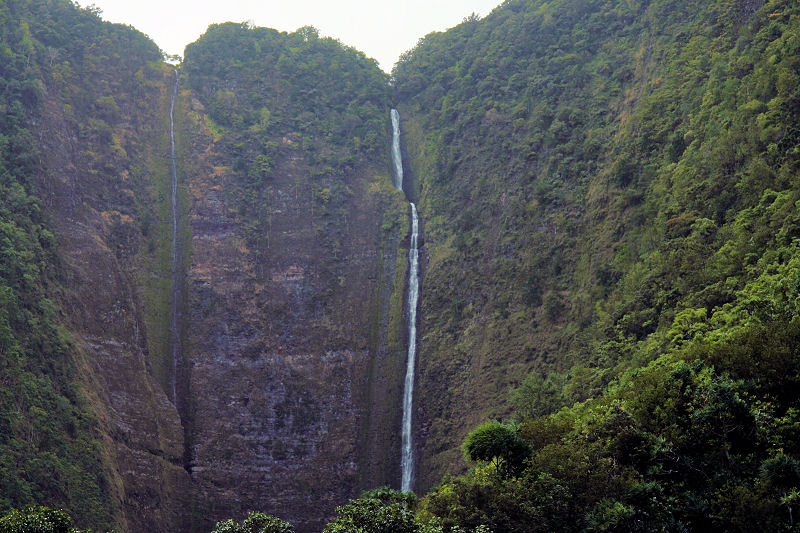
I had not hiked the Waipio Valley in over a decade - and I had a never ending burning desire to hike in this remote and austere valley. I read about some of the magestic waterfalls that lay hidden deep in the valley - only to be seen by adventurous hikers. I zeroed my sights in on the famous Hiilawe Falls - a 1400 foot high waterfall at the back side of the Waipio. I knew that hiking up to the waterfall would be a challenge.

I studied a 1:24,000 topo map of the valley and even entered a few coordinates (including the location of the falls) into my GPS for situational awareness. We loaded up on water and my camera and began our hike down the narrow switch-back road from the Waipio Valley Lookout to the valley floor below. The hike down provided a wide panoramic view of the Waipio Valley - as you hiked further and further down the road, you saw a more expansive view of the valley, the farm lands beneath, the black sand beach at the mouth of the valley, and the steep trail scaling the north cliff face leading you over to the next valley, the Waimanu Valley. We spotted several hawks flying overhead, welcoming us to the valley.

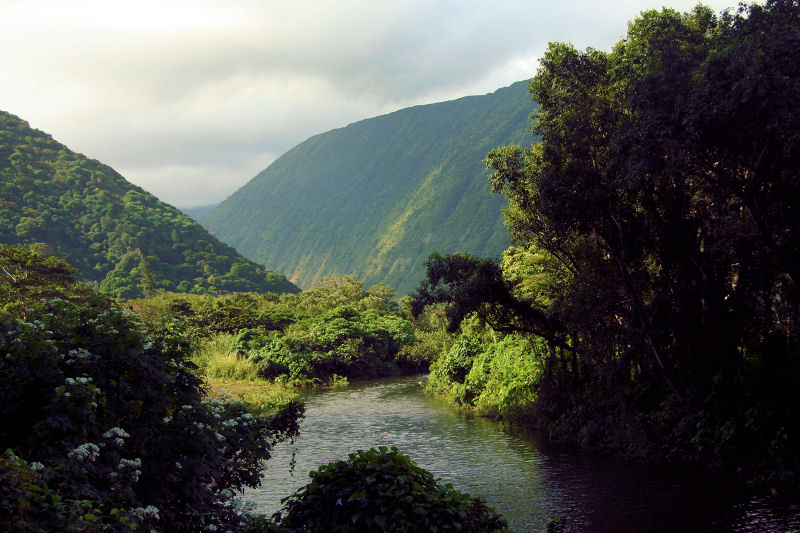
You could see small houses and primitive shelters used for farming taro in the fields below. A river winds its way through the middle of the valley - probably fueled by water from the waterfalls. Once we got to the bottom of the valley, we turned left (west) and followed a rough road towards the back end of the valley. Towering fruit trees line the road and the plant life was vibrantly alive - you could smell the freshness and fertility in the air. As the road neared its end, we caught glimpses of Hiilawe Falls in the background and we knew the general direction we needed to go. At this point we wandered down a path (left turn from the road) and ended up passing by several houses. We continued and the trail for the most part ended, but by using the GPS we knew to continue. This led us through a set of taro fields - which are much like rice paddies, water-soaked fields blocked in by man-made walls. We traversed the fields and ended paralleling a stream in the forest.

Then the trail ended abruptly - in front of us was deep water at a bend in the river and on our left and right high, steep rocky canyon walls. We were at a bottle neck with nowhere to go but wade through deep water - my GPS said we were only 0.25 miles from the falls! A mere quarter mile from our goal and it looked unpassable - unless we waded through this deep water with our packs on and camera equipment to get wet, we wouldn't get to the falls.

We decided to turn back and hike down to the black sand beach and enjoy the sights there, a little deflated, at least we saw the majestic Hiilawe Falls. At the beach we saw the mighty Pacific Ocean waves crashing on the shore. Right here in the shade of the coniforous trees, wild horses grazed in the grass, oblivious to us. The raw natural beauty of the Waipio is incredible!

Labels: ,

Friday, December 22, 2006

Hike to the Active Lava Flow

We decided to hike once again to watch the active lava flow of Kilauea volcano at the Hawaii Volcanoes National Park. We have done this many times now, but wanted to do it once more - plus, we have some new camera equipment that we wanted to try out. As usual, we stopped in to the visitor's center to ask them about the lava conditions and how long the hike would be (the conditions change almost daily). On this occassion it turned out to be about a 3.5 mile hike each way.

We chose to start the hike in the late afternoon to ensure we arrived at the viewing spot prior to sunset - that way we get to see the lava flow as the sky and sun change in the early evening. Also, this way we only have to hike one way in the dark. We were prepared with sturdy hiking boots, lots of water, jackets (it frequently rains here), one flashlight per person, and of course our camera equipment including tripod.

It was not surprising to see so many people unprepared for the long hike - many with open-toed sandals, many without water or even a flashlight. On our return hike from the lava flow back to the car, as we crested a hill, we came across a young girl about 20 years old, alone and crying in the dark. We tried to console her and see if she needed any help - it tourned out that the hike was too long and she did not want to go further, so her friends just left her on this hill in the dark with no flashlight, in the wind with a light rain beginning to fall! At this point she was about 1.75 miles from the car and the same distance to the lava flow - too far to walk alone in the dark with no light. The last group of hikers we saw were starting their hike at 8:00PM - which puts them back at the start somewhere around 1:00AM! Be smart when you hike in Hawaii - nature can be unforgiving.

The hike was definitely worth it - it was a surreal setting with the crowd silent in the dark watching the dramatic lava flow as the sun set in the background. The bright flashes of lava entering the ocean, and the hard-hitting waves pounding the shore mesmerized you. We got back to our car at about 9:00PM and we were starving! I had left me dinner in the car not thinking that I would be hungry long before this - so we chowed down on some stir-fried noodles that we had bought earlier and then drove back to Hilo for the night.

Labels: , ,

Monday, December 11, 2006

New Inter-Island Airline

I just flew from Oahu to the Big Island today. I got a chance to try out the new inter-island upstart called Go! (a subsidiary of Mesa Airlines). They fly Regional Jet (RJ) aircraft between the Hawaiian Islands. The have started a mini price war between all the other inter-island airlines (such as Aloha and Hawaiian Air) due to their cut-rate budget prices. All-in-all I enjoyed my flight on Go! Airlines - one quirk about them is that you depart out of the Commuter Terminal at Honolulu International, which is a separate, smaller building set aside next to the regular inter-island terminal. If you want to save money, check out IFlyGo.com

Labels: